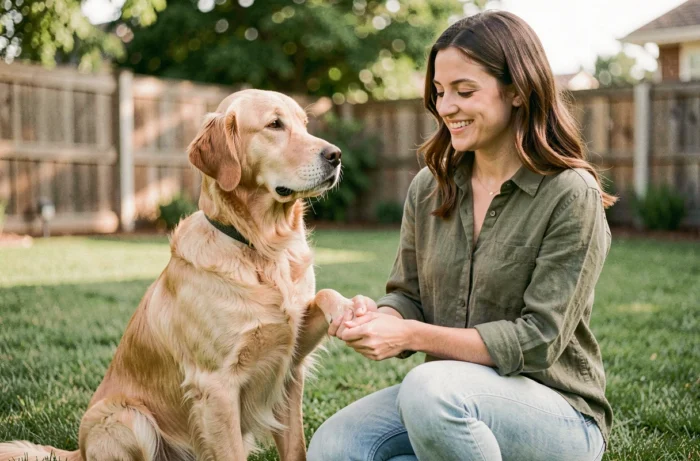
A colleague adopts an Australian shepherd because he loves its appearance, but finds himself overwhelmed after three weeks: the dog destroys the sofa, barks as soon as it is alone, pulls on the leash. The problem does not come from the dog. It stems from a mismatch between the energy level of the breed and the actual daily life of the household.
Before discussing breeds, advice, or diet, we establish the foundation: understanding what a dog needs on a daily basis and verifying that we can provide it.
Commitment Certificate: the legal step before any dog adoption
Since the implementation of the commitment and knowledge certificate, anyone acquiring a dog must receive this document at least seven days before the actual transfer. This rule applies equally to purchases from breeders and adoptions from shelters, whether free or paid.
This mandatory reflection period has a concrete purpose: to reduce impulsive adoptions that lead to abandonment. We sign the certificate, wait seven days, and only then does the dog join the household. In practice, this time allows for preparing the living space, purchasing basic equipment, and confirming that the whole family is ready.
If going through a foster family associated with a shelter, the legal framework clearly distinguishes between temporary housing and ownership. The foster family materially keeps the animal without becoming its owner. If they then wish to adopt it, a formal transfer remains necessary. Detailed information can be found on dogs on Attitude Canine, which includes breed profiles and practical advice to support this process.
Dog breeds and lifestyle: concrete criteria to avoid mistakes
Competitors often list breeds by category (families, sporty, seniors). The real selection filter is the intersection of three parameters related to your daily life.
- Available space and outdoor access: an apartment in the city center without a garden is suitable for a Cavalier King Charles, but not for a Beauceron that needs to expend energy for several hours a day
- Time spent at home: a dog like the Malinois or Border Collie struggles with prolonged solitude, while a Greyhound happily sleeps the majority of the day once its running needs are met
- Veterinary and food budget: large breeds are significantly more expensive in terms of food and veterinary care, and some brachycephalic breeds (French Bulldog, Pug) accumulate consultations related to respiratory issues
You don’t choose a golden retriever just because it is sociable. You first check that you can offer it one to two hours of daily activity, regular grooming of its dense coat, and appropriate veterinary follow-up for its joint predispositions.
Molossoids and Malinois: dogs that are harder to place
SPA data shows an overrepresentation of molossoid-type dogs and Malinois among animals taken in by shelters. Prejudices related to these breeds, combined with certain regulatory constraints (categorization, muzzle requirement in public spaces), hinder their adoption.
For an experienced owner with space and time, these dogs can be reliable companions. The problem is not the breed, but the mismatch with the owner’s profile.
Dog training: mistakes that create behavioral problems
Behavioral problems are among the top reasons for abandonment. Excessive barking, destruction, fear-based aggression: these issues do not arise by chance. They most often result from a lack of early socialization or inconsistency in the rules imposed on the dog.
Socialization must begin before the puppy is four months old. It should be gradually exposed to various noises, other dogs, and different environments. After this window, learning remains possible but requires much more time and patience.
Three concrete principles can help avoid most pitfalls:
- Establish the rules from day one and stick to them: if the dog is not allowed on the sofa, no one in the household should give in
- Reward the desired behavior rather than punishing the mistake: a dog that receives a treat when it comes back on command learns faster than a dog that is scolded afterward
- Adapt the duration of training sessions to the dog: a puppy can only maintain attention for a few minutes, an adult can work for fifteen minutes, but beyond that, the quality of learning decreases
Owner’s life changes: anticipate rather than abandon
Moving, childbirth, separation: changes in the owner’s situation are a major reason for taking in dogs at shelters. Prevention involves concrete solutions. One can arrange temporary care with a relative, hire a pet sitter, or consult a canine behavior educator to adapt cohabitation.
A dog prepared for absences and transitions adapts to most upheavals. Learning gradual solitude from a young age remains the best assurance against crises.

Dog health and nutrition: what varies by size and breed
The diet of a Chihuahua and that of a Great Dane have nothing in common, neither in quantity nor in composition. Small dogs have a fast metabolism and need kibble that is more concentrated in energy. Large breeds require a diet that protects their joints, with controlled calcium intake during growth.
Veterinary follow-up is not limited to annual vaccinations. A complete health check at least once a year detects silent pathologies: early renal failure, dental problems, thyroid disorders. For at-risk breeds (German Shepherd and dysplasia, Cavalier King Charles and heart murmur), targeted screening is necessary from the early years.
Coat maintenance also varies significantly. A golden retriever requires weekly brushing to avoid tangles and monitor for parasites. A short-haired dog like the pointer only needs a quick grooming glove pass.
Choosing a dog, training it, and supporting it over time is based on a simple principle: know its real needs before committing. The commitment certificate requires seven days of reflection. One can take this opportunity to verify that they have the time, space, and budget to provide this companion with the life it deserves.