
The development of a baby is played out in the micro-interactions of daily life: the quality of an exchange during a diaper change, the type of sensory stimulation offered on the floor, the management of transition moments. The key principles are known to informed parents. The difficulty lies in their concrete application, especially when fatigue, screens, or family constraints come into play.
Screens and babies in daily life: applying the ban without rigidity
The decree of June 27, 2025, has transformed the recommendation into an obligation for early childhood care structures and childminders: screen exposure for children under 3 years old is now prohibited. At home, the rule remains a recommendation, but it weighs heavily on parents.
The Terra Nova report reminds us that the problem is not limited to raw screen time. What matters is what the screen replaces: free play, conversation, face-to-face interaction. A baby passively exposed to a video loses an opportunity for exchange. A video call with a grandparent, on the other hand, generates verbal and emotional interaction if the adult present supports the exchange.
Three ordinary situations deserve precise framing:
- During meals, the screen cuts the sensory loop between the child, the food, and the adult. Removing the screen from the table is not enough if the television remains on in the background in the adjacent room.
- Family video calls work as long as the parent comments, names the faces, and the call remains short. The baby is not looking at a screen; they are participating in an exchange mediated by the adult.
- Moments of parental fatigue are the most challenging. Placing a baby in front of an animation for ten minutes to take a breather does not have the same effect as an hour of passive exposure. Focusing on moments and places rather than feeling guilty about total time helps maintain manageable reference points.
Ground sensory stimuli: what play catalogs don’t say
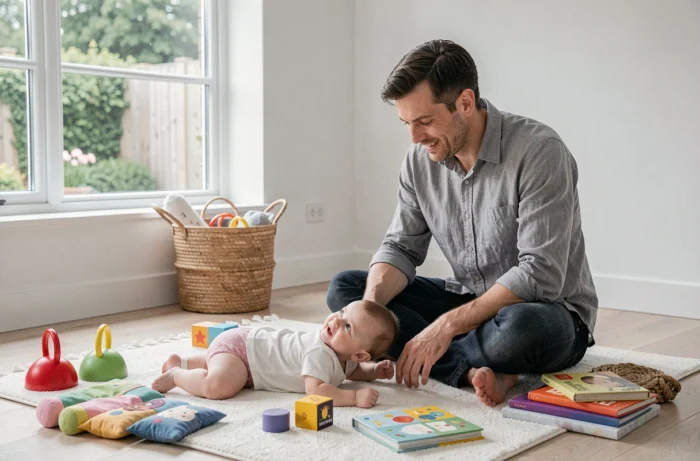
Play mats and hanging arches saturate the infant’s visual field without always respecting their actual perceptual abilities. Before three months, a baby distinguishes strong contrasts at a short distance. Pastel mobiles or multicolored toys a meter away from their eyes do not provide any usable stimulation.
Time spent on the floor, first on their back and then on their tummy, remains the main motor lever. Free play without imposed objects encourages autonomous exploration: the baby turns their head, grabs their foot, rolls. Adding a single, contrasting object within reach is enough to enrich the sequence. Multiplying simultaneous stimuli (music, light, textures) fragments attention and can cause overstimulation, visible through crying or averted gaze.
Parents looking for suitable materials for each stage will find on the P Comme Plimplim website a selection organized by age, which avoids blind purchases.
Verbal interactions during care: transforming routines into a development lever
Diaper changes, baths, and dressing represent several dozen minutes daily. These moments are often treated as logistical tasks. However, they constitute privileged windows of exchange because the baby is contained, in physical contact, and the adult is available (no cooking in progress, no siblings to manage).
Naming each gesture and each body part during care builds receptive vocabulary long before the first words appear. The baby does not understand lexical meaning, but they integrate prosody, conversational rhythm, and turn-taking. Responding to their vocalizations, even with a simple repetition, reinforces the communication loop.
Two concrete practices enhance the quality of these exchanges:
- Verbally announcing each step before carrying it out (“I’m going to lift your legs”) gives the baby a temporal reference and reduces surprise reactions, especially after four months.
- Leaving a silence after a sentence allows the baby to produce a vocal response. This latency time, often overlooked by hurried adults, establishes the dialogue pattern from the earliest months.
Food and sensory exploration: do not separate the two
Introducing solid foods is often approached from a nutritional perspective. It is also a major sensory activity. Touching, squishing, bringing to the mouth, smelling: each meal engages fine motor skills, hand-eye coordination, and the integration of new textures.
Accepting messiness is part of the process. A baby who squishes a piece of banana between their fingers before tasting it is not playing with food. They are exploring an unknown material using the only method available to them: direct manipulation.
Offering a variety of textures from the start of weaning (and not just smooth purees) stimulates chewing and reduces later food refusal behaviors. The condition: the adult must remain present, attentive, and the meal should not be disrupted by a screen or continuous background noise.
The development of a baby cannot be programmed like a marked path. Month-by-month reference points remain useful for identifying potential delays, but daily life is played out in the quality of ordinary interactions. Protecting mealtime, care, and free play moments from passive interferences, whether from screens or sensory overstimulation, forms the most solid foundation for supporting each stage.