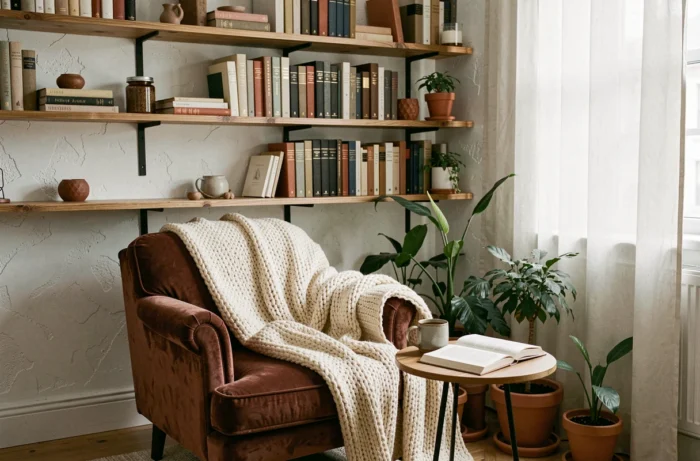
A domestic cocoon relies on a balance between thermal comfort, air quality, and material choices. Transforming your home into a cocoon is not just about piling blankets on a sofa: it’s a process that involves insulation, light, materials, and ventilation to create an interior where well-being is felt physically.
Thermal comfort room by room: the foundation of a cocoon interior
Before thinking about decoration, a cocoon starts with a temperature suitable for each use. ADEME’s recommendations distinguish between occupied living spaces, bedrooms at night, and unoccupied rooms. Heating the entire house uniformly does not create comfort, but waste.
The living room, where we spend the most time sitting or lying down, requires a slightly higher temperature than the kitchen, where physical activity compensates. The bedroom benefits from a few degrees cooler for better sleep quality. Adjusting the temperature to the use of each room transforms the feeling of comfort much more effectively than an extra blanket.
A well-insulated home retains this modulated heat effortlessly. Checking the condition of window seals, identifying thermal bridges around shutter boxes or under entrance doors are concrete actions that change the thermal perception of an entire room. To find more information on lescope.fr, each area of home improvement is detailed by category.
Indoor air quality: the trap of candles and ambient fragrances
Scented candles, incense, and oil diffusers are featured in most cocooning advice. Their olfactory effect is real, but their combustion emits particles and other pollutants that degrade indoor air quality.
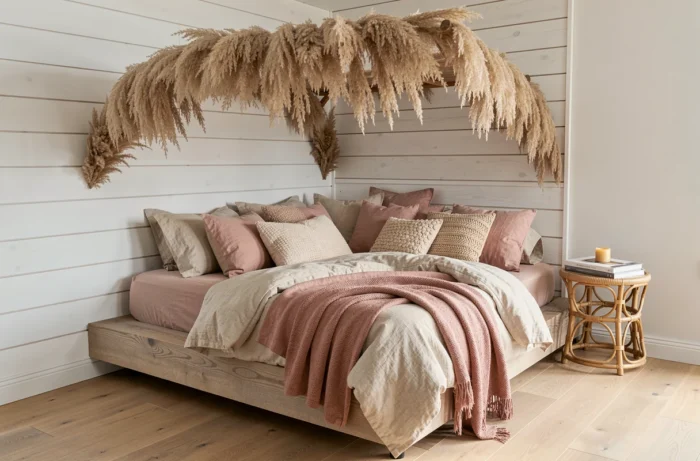
Accumulating textiles, cushions, and thick curtains in a poorly ventilated room exacerbates the problem. Fibers trap dust and allergens, and without sufficient air renewal, the atmosphere becomes heavy. The feeling of comfort then disappears despite careful decoration.
Ventilation and airing after each use
The basic rule: keep the mechanical ventilation system operational and never obstruct the extraction vents, even for aesthetic reasons. After cooking, showering, or lighting candles, airing the room for a few minutes is enough to restore healthy air.
A true cocoon remains a space where one breathes well. Persistent humidity on windows or in wall corners signals an imbalance that no decorative accessory can correct. Addressing the cause (ventilation, insulation) before dressing the space prevents turning your cocoon into a mold trap.
Materials and textures: choose based on touch, not trend
Cocooning relies on physical contact with surfaces. A corduroy sofa, a short-pile wool rug, a raw wood table: each material produces a distinct tactile sensation. The relevant choice is made according to the touch desired in each area of the house.
- Washed linen, slightly wrinkled, is suitable for cushion covers and light curtains. It softens light without weighing down the room, and its texture improves with washing.
- Looped wool on an armchair or pouf adds visual density and a warm touch, suitable for reading corners or bedrooms.
- Raw or simply oiled wood, on a shelf, tray, or countertop, introduces a surface irregularity that breaks the monotony of smooth, uniform interiors.
Mixing two to three natural materials per room creates sensory richness without overloading the space. A common mistake is to multiply accessories in a single texture (all faux fur, all velvet), which produces a uniform and suffocating effect instead of a nuanced cocoon.
Soft light in the living room: color temperature and positioning
Lighting dictates the ambiance more than any other decorative element. The technical notion to remember is color temperature, expressed in kelvins. Warm temperature bulbs produce an orange light conducive to relaxation, while cool temperature bulbs lean towards blue and stimulate wakefulness.
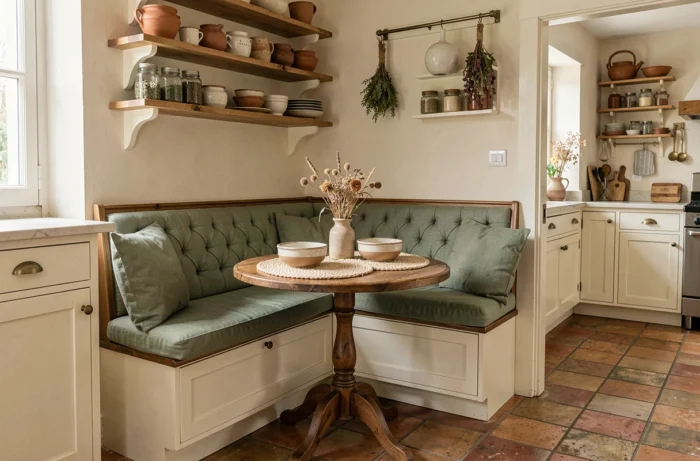
For a cozy living room, prioritize light sources below the cool light threshold. Table lamps and string lights positioned at eye level or below (floor lamp directed towards the ceiling, table lamp) diffuse indirect light that envelops the room without glare.
Multiplying light points rather than a single ceiling fixture
A central ceiling fixture lights uniformly, which flattens volumes and eliminates shadow areas. A cocoon interior works the opposite way: it creates islands of light. A reading lamp near the armchair, a string light on a shelf, an LED candle on the coffee table.
Three to four low light sources are sufficient for a standard-sized living room. Each defines a micro-space (reading, conversation, resting) and gives the eye points of interest that make the room lively, even in the evening.
Comfort all year round: thinking of the cocoon beyond winter
The cocooning reflex often kicks in during autumn, with a desire for warmth and thick textiles. A truly comfortable interior is also considered for the warm months. A well-insulated home also protects against summer heat, limiting excessive solar gains through shutters, exterior blinds, or effective roof insulation.
Replacing wool blankets with linen throws, swapping thick cushions for lighter cotton versions, opening windows during cool hours, and closing shutters and curtains during the day: these seasonal adjustments prolong the cocoon feeling without resorting to air conditioning.
The cocoon is not a fixed decorative style. It is a permanent adjustment between what the home offers (insulation, ventilation, natural light) and what is added (materials, lighting, furniture arrangement). Decorative accessories come last, once the structure is doing its job properly.