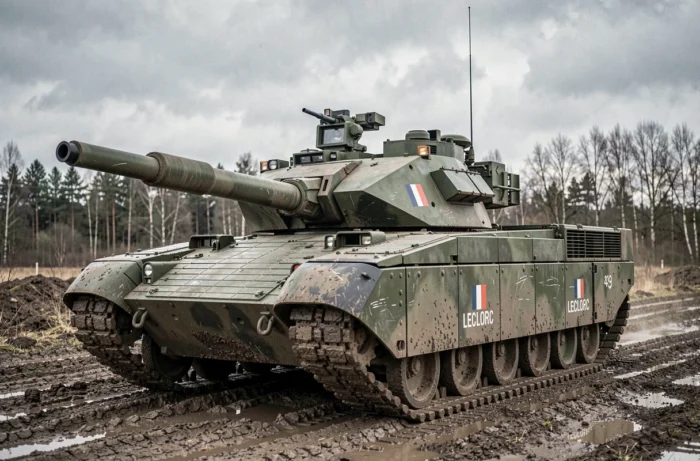
The Leclerc tank, put into service in 1993 with the 501st/503rd Combat Tank Regiment of Mourmelon, remains the only Western battle tank capable of firing at a fixed target at 4,000 meters while moving. Three decades later, the question is no longer whether it will be replaced, but how France plans to manage the transition between an aging vehicle, a Franco-German program (MGCS) that is behind schedule, and an interim solution still at the proposal stage.
Leclerc XLR, CAPINT, and MGCS: Comparative Data of the Three Programs
Comparing these three milestones allows us to measure the gap between what is operational today, what could be operational tomorrow, and what remains on paper.
| Program | Status | Main Gun | Turret | Capability Horizon |
|---|---|---|---|---|
| Leclerc XLR | In service (upgraded) | 120 mm (range 4,000 m, 6 rounds/min) | Manned, 3 crew members | Operational now |
| CAPINT (KNDS) | Industrial proposal, not ordered | ASCALON (new generation) | Unmanned | Studies to be launched by 2030 |
| MGCS | Program under rewrite | Not publicly defined | System of systems architecture | First capability around 2035 (estimate) |
The Leclerc XLR is the only line in this table that corresponds to delivered and deployed equipment. Understanding the evolution of the Leclerc tank involves this distinction between operational equipment, industrial offer, and still unstable cooperative program.
Operational Maintenance of the Leclerc: An Industrial as Much as a Military Challenge
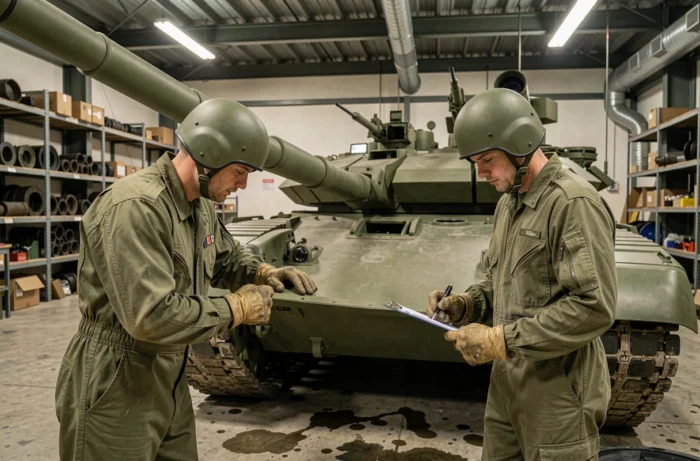
The maintenance of the turbomachinery of the Leclerc tank is a central issue: the availability of the engine conditions the entire operational chain of the French armored fleet.
Rather than waiting for a hypothetical successor, the Army is securing the powertrain of its current tank during the transition period.
The Leclerc XLR also features enhanced armor, a GALIX system, NBC protection, and a carrying capacity of 40 shells including 22 ready-to-use rounds. The onboard computing and data transmission make it a connected weapon system, not just a gun on tracks. The secondary armament includes a 12.7 mm coaxial machine gun and a 7.62 mm machine gun in the superstructure.
CAPINT and the Intermediate Tank Concept Before MGCS
KNDS presented CAPINT as a response to the risk of a capability gap between the gradual withdrawal of the Leclerc and the arrival of the MGCS. The concept combines three distinct elements:
- A chassis derived from the Leopard 2, a proven and mass-produced platform, which would reduce development times compared to a completely new design
- A unmanned turret integrating the ASCALON gun, developed by Nexter, which marks a break from the manned turret of the Leclerc
- Accompanying robotic vehicles, designed for anti-drone operations and reconnaissance, which transform the tank into a node of a tactical network
CAPINT remains an industrial proposal. No official order has been placed. France plans to launch studies by 2030, with the first capability expected around 2035. The Leclerc XLR will therefore have to coexist with an interim solution rather than disappearing in favor of the MGCS.
Franco-German MGCS: Reasons for a Stalemate
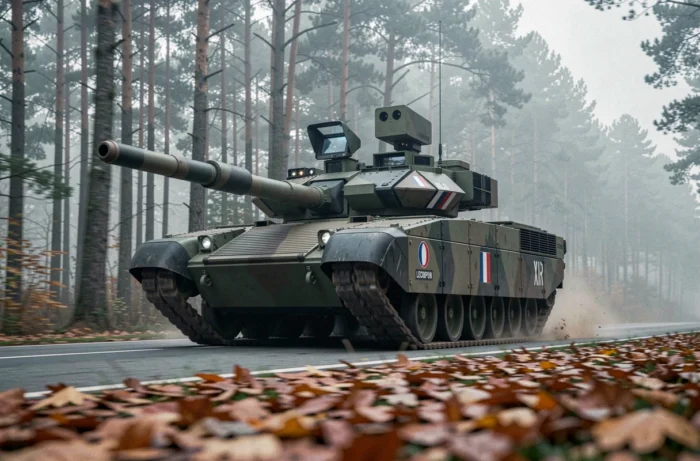
The Main Ground Combat System was supposed to embody industrial defense cooperation between Paris and Berlin. The facts tell a different story. The program is under rewrite, and the divergences between the two partners on technological sharing and industrial management have only intensified.
This divergence is not just a dispute over industrial leadership. It touches on the very doctrine of the future armored vehicle. The post-Leclerc is envisioned as a system of systems, with an open digital architecture, anti-drone capabilities, and coordination between manned and robotic vehicles. Operational value would no longer rely solely on the armor and gun of the main tank.
The French and German timelines do not converge. Germany is advancing on its own solutions while France launches studies for an intermediate tank. This desynchronization makes the MGCS increasingly hypothetical in its initial form.
Doctrinal Break: The Combat Tank is No Longer the Central Piece
One point clearly emerges from recent analyses: the tank still has a future, but it is no longer the centerpiece of air-ground combat. The war in Ukraine has confirmed the vulnerability of heavy armored vehicles to drones and loitering munitions. The concepts emerging around CAPINT or MGCS integrate this reality.
The challenge is no longer to design the most powerful tank, but the most resilient system.
- Open digital architecture allowing the integration of third-party sensors and effectors
- Unmanned platforms for high-risk missions (reconnaissance, demining, decoy)
- Integrated anti-drone capabilities from the design stage, not added as an afterthought
The choice of a Leopard 2 chassis for CAPINT reflects the desire to rely on a platform already mass-produced. Rebuilding a complete industrial sector will take years, regardless of the program chosen.
Between a Leclerc XLR whose maintenance is now secured, a CAPINT still on paper, and an MGCS losing momentum, the French trajectory relies on a bet: to maintain an aging tank long enough for the next generation to arrive before the capability gap becomes an operational breach. The planned studies by 2030 will provide a real measure of this ambition.