When you take a batch of grapefruit slices out of the oven and they are still sticky in the center after several hours, the problem rarely lies with the cooking time. It’s the thickness of the cut and the management of residual moisture that make the difference between a successfully dehydrated citrus fruit and one that will mold in its jar within two weeks. Lemons and grapefruits are not treated the same way, and a few precise adjustments change the entire outcome.
Dehydrated Grapefruit: Why It Causes More Problems Than Lemon
The pulp of grapefruit is significantly bulkier and juicier than that of lemon. You often end up with an exterior that seems dry while the center of the slice remains moist. This discrepancy is the main cause of mold during storage.
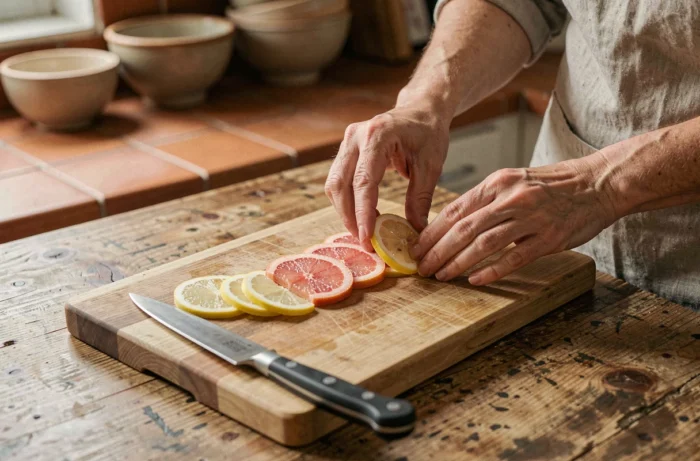
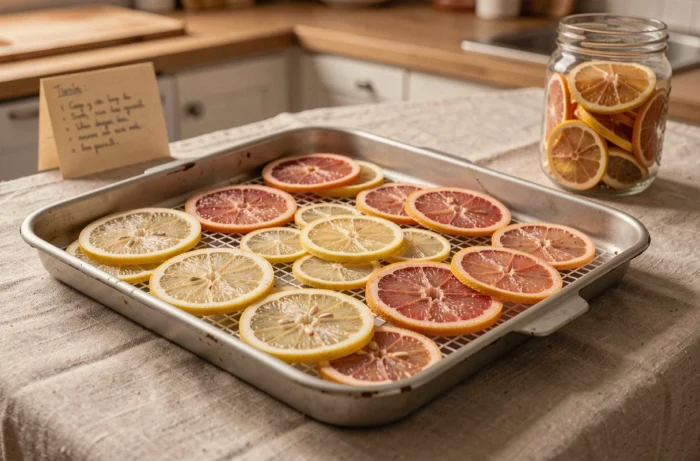
To remedy this, we focus on two parameters. First, thin and even slices, not exceeding half a centimeter in thickness for grapefruit. A sharp knife or a mandoline solves the problem. Next, space each slice on the rack without overlapping, in a single layer, to allow air to circulate everywhere.
Lemon, being thinner and less juicy, is more forgiving of approximations. You can slightly increase the thickness without too much risk. To learn how to make dehydrated lemons and grapefruits properly, this difference in treatment between the two fruits is the first point to master.
Temperature and Drying Time in the Oven or Dehydrator
The classic temptation is to raise the temperature to speed things up. The result: the edges burn, the center remains soft, and the slice has neither color nor flavor that can be used.
A low temperature and a long time yield a uniform result. In the oven, we stick to low-temperature convection heat. In the dehydrator, the principle is the same: a constant airflow at moderate heat.
The duration varies depending on thickness, fruit, and ambient humidity. Feedback varies on this point, but the reliable rule is to rely on the state of the slice rather than a timer. A ready slice bends slightly without breaking cleanly and no longer feels sticky to the touch.
Tip for Checking Internal Drying
A slice that appears dry when it comes out of the oven may still contain moisture in the center. Let it cool completely, then place the slices in a closed jar for two to three days. If condensation appears on the walls of the jar, the drying is incomplete and the slices need to be dehydrated again.
This simple test avoids the unpleasant surprise of discovering mold a week after jarring.
Pre-treatment of Citrus Fruits Before Dehydration: Washing and Citric Acid
You eat the whole slice, including the zest. Washing is therefore not optional. For non-organic citrus fruits, soaking in a solution of water and baking soda for a few minutes helps reduce surface residues. Rinse thoroughly with clear water afterward.
For organic citrus fruits, a simple rinse under running water while scrubbing is sufficient, but be sure to dry each fruit thoroughly before cutting. Residual water on the skin unnecessarily prolongs the drying time.
Citric Acid Bath Against Browning
A brief soak in water mixed with lemon juice or citric acid limits oxidation and preserves the bright color of the slices. Pink grapefruit, in particular, looks much more appetizing with this pre-treatment.
Be sure to drain the slices well after the bath. Any excess liquid slows down dehydration and creates exactly the problem we are trying to avoid: a moist center under a dry surface.
Recipes and Practical Uses for Homemade Dehydrated Citrus Fruits
Once the slices are ready, they quickly go beyond decorative use. Here are the uses that make the most of the concentrated flavor of dried citrus fruits:
- In infusion or herbal tea, a slice of dehydrated lemon releases a more intense aroma than fresh zest, without the bitterness that appears when you soak a raw lemon for too long.
- Blended into powder in a blender, dehydrated grapefruit slices can be incorporated into a homemade spice mix (with salt, pepper, and chili) to season fish and shellfish.
- In mulled wine or a cocktail, the dehydrated slice holds up better than a fresh slice, does not disintegrate, and gradually releases its fragrance.
- Coated with a layer of dark chocolate, dehydrated lemon slices become a homemade candy with a very distinct bitter-sweet contrast.

Citrus Powder: An Underestimated Condiment in Cooking
Passing the slices through a blender yields a fine powder that can be stored for several months in an airtight jar. This powder replaces fresh zest in pastries, dressings, or marinades. It offers a practical advantage: it is available all year round, even out of citrus season.
You can mix lemon and grapefruit in different proportions depending on the use. More grapefruit for a floral note, more lemon for a sharp acidity.
Storage of Dried Lemons and Grapefruits Without Mold
Storage should be done in airtight containers, away from light and moisture. A glass jar with a tight seal remains the most reliable choice.
Avoid fabric bags or poorly sealed boxes, which allow ambient moisture to slowly rehydrate the slices. Under good conditions, homemade dehydrated citrus fruits can be stored for several months without significant loss of flavor.
If you doubt the drying, it’s better to keep the slices in the refrigerator for the first few weeks and monitor for any suspicious signs. A well-dried batch, checked with the closed jar method, will pose no problem at room temperature.