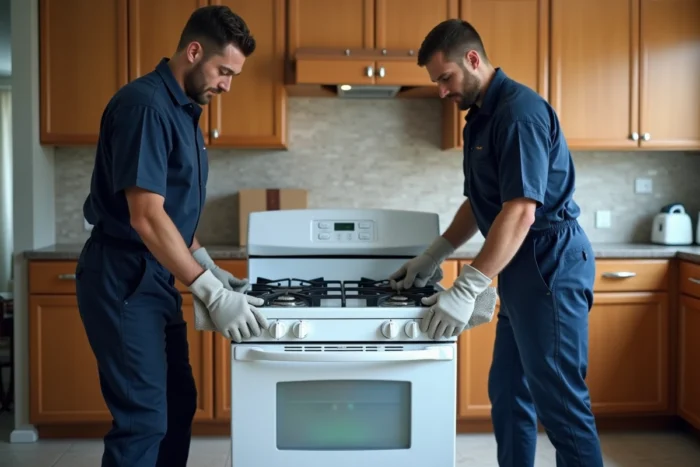
A stove weighs between several dozen and over a hundred kilos depending on the model. Its transport involves mechanical constraints (weight, high center of gravity, fragile components) and technical precautions related to the type of energy used. Transporting a stove without damage requires understanding these constraints before choosing a handling method.
Risk of oil reflux: why the tilt of a stove matters
Competitors talk about protecting the appliance from shocks, but very few address a technical phenomenon that conditions its re-commissioning. Some electric and induction stoves contain insulating oil inside their tubular heating elements. When the appliance remains horizontal or heavily tilted for a long time, this oil can migrate to the connection terminals.
This reflux creates a risk of short-circuit or failure on the first ignition. Recent guides from manufacturers like Bosch-Siemens specify that induction stoves transported lying down must rest in a vertical position for several hours before being reconnected, allowing the insulating oil to return to its place.
If you need to know can you transport stoves with 123 Net Immo, the answer also relates to this post-transport resting constraint. In practice, vertical transport remains the safest solution. If tilting is unavoidable, limit it as much as possible and allow a resting time of at least several hours, or even a full day, before powering on.
If the appliance traveled lying down, a visual inspection of the electrical connections is necessary. Cleaning the terminals with isopropyl alcohol removes oil residues and prevents any issues during restart.
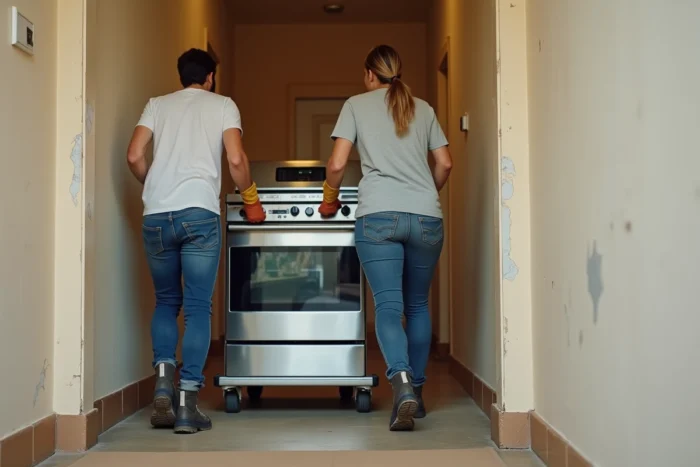
Safe disconnection of a gas or electric stove
Before any handling, the stove must be completely disconnected from its power source. The procedure varies depending on the type of appliance.
Electric or induction stove
Unplug the wall socket or turn off the circuit breaker dedicated to the cooking circuit. On models connected via cable output (without a plug), removing the terminal block requires an insulated screwdriver and a voltage absence check with a tester. Identify the wires by color or labeling before detaching them: this will facilitate reconnection.
Gas stove
Close the gas supply valve on the wall, then unscrew the flexible hose. Check the validity date of the hose: an expired hose should not be reused in the new home. If you smell gas after disconnection, ventilate the room and do not touch any electrical switches.
For both types, wait until the appliance is completely cooled. Clean the burners, grates, and the inside of the oven to prevent food residues from shifting during transport and damaging the surfaces.
Bracing and protection for transporting a stove
Once cleaning is complete and the appliance is disconnected, the packaging phase determines the arrival condition.
- Remove all removable parts (grates, trays, drip trays, knobs) and pack them separately in bubble wrap or cardboard. A broken knob in transit is an expensive and sometimes hard-to-find replacement on older models.
- Secure the oven door with wide packing tape, applied in a cross pattern. On models with soft hinges, a door that opens during handling alters the center of gravity and can cause tipping.
- Wrap the entire appliance in thick moving blankets, secured with straps. The corners and the glass surface (ceramic glass, oven door) deserve double thickness protection.
- For long-distance transport, logistics professionals use a reinforced crate made of OSB or plywood with screws around the base and polyethylene foam bracing. This method reduces lateral shocks and internal movement.
Handling and loading without risk of injury
The weight of a standard stove far exceeds what one person can lift alone without back risk. Two people are the minimum, three for a cooking range.
A strap-handling cart remains the best ally. Tilt the appliance slightly backward, slide the base of the cart under the stove, then strap it securely. For stairs, a stair-climbing cart avoids jolts and distributes the load over each step.
Wear cut-resistant gloves (the metal edges at the back are often sharp) and safety shoes. Keep your back straight, bend your knees: the push should come from the legs, not the spine.
In the transport vehicle
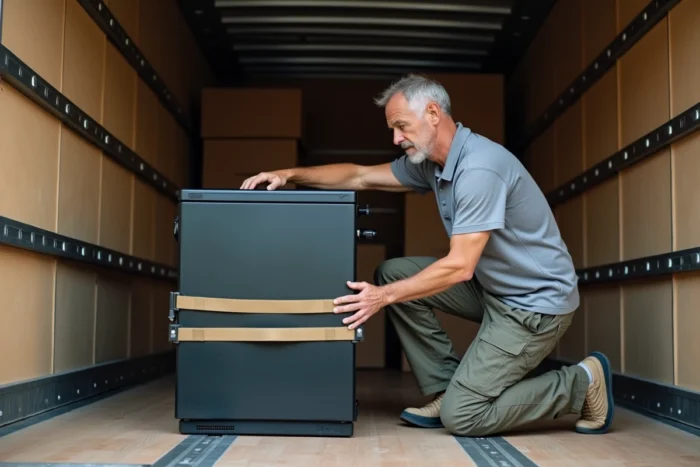
Place the stove in a vertical position, back against the wall of the truck. Brace it with other heavy furniture or ratchet straps fixed to the vehicle’s anchor points. No object should rest on the cooking surface, even if protected: concentrated weight can crack a ceramic glass plate or deform a burner.
If vertical transport is impossible (low ceiling vehicle), lay the appliance on its back (never on the front glass side) and remember the vertical resting constraint before re-commissioning.
The last point to check after delivery concerns the connection. On a gas stove, a soap-water leak test on each connection remains the most reliable method to detect a micro-leak. On an electric model transported lying down, wait the necessary time, check the terminals, then perform a gradual first ignition while monitoring for any unusual smell or noise.