Antique silverware circulates abundantly on the second-hand market, in estates, flea markets, and auctions. To distinguish a solid silver piece from a silver-plated or silver-filled item, the hallmark remains the first element to examine. However, one must know how to read it, locate it on the object, and understand what it actually guarantees.
French silver hallmarks: what the shape and location reveal about the grade
On an antique piece made in France, the guarantee hallmark certifies the grade of the alloy, meaning the proportion of pure silver it contains. This hallmark is applied by the guarantee office (tax administration), not by the silversmith himself. This is a distinction often overlooked.
The most common grade hallmark on pieces produced after 1838 is the First-grade Minerva (950 thousandths). It appears as a profile of a helmeted woman inscribed in an octagonal cartouche, accompanied by the number 1. A number 2 indicates the second grade (800 thousandths), which is significantly less common on tableware.
Before acquiring a service or a lot, it may be useful to check the hallmarks on French Home to compare the visible marks on your pieces with the documented references by period.
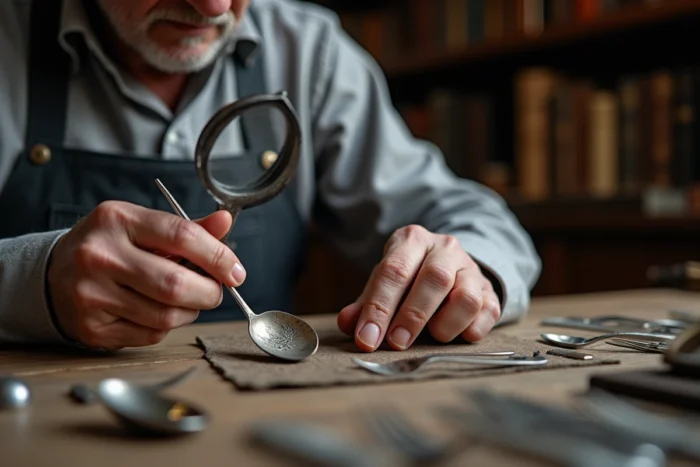
The location of the hallmark varies depending on the type of utensil. On a fork, it is usually found at the base of the tines or on the stem, on the back side. On a spoon, it is stamped on the back of the bowl or on the handle. A turned-over piece, examined under good raking light, almost always reveals its marks.
Master hallmark and guarantee hallmark: two marks, two distinct functions
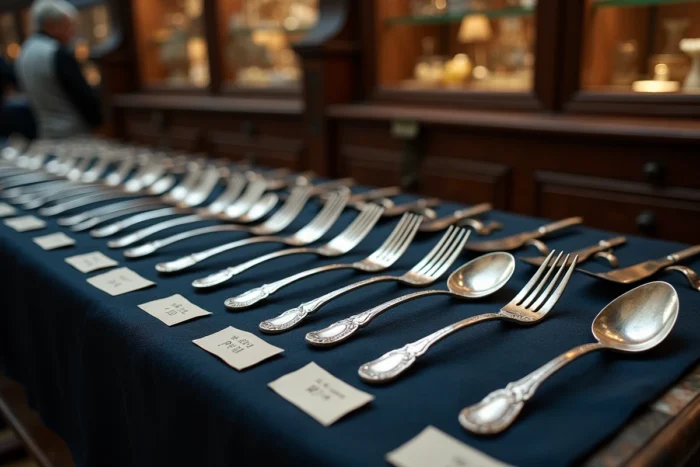
An antique solid silver piece bears at least two hallmarks. Confusing them skews the analysis.
- The master hallmark (or silversmith’s hallmark) identifies the manufacturer. It features their initials framed by a unique symbol, all inscribed in a diamond shape. This hallmark is stamped by the artisan before presenting the item to the guarantee office.
- The guarantee hallmark (Minerva, Vieillard, rooster’s head depending on the era) certifies that the alloy has been verified by the State. It attests to the silver content.
- On pieces made before 1798, a third hallmark may appear, that of the general farmer, responsible for collecting duties on precious metals. These marks, often very worn, make dating more challenging.
An item that bears only a master hallmark without a guarantee hallmark poses an authentication problem. It may be a piece not presented to the office, a counterfeit, or a foreign object stamped with a hallmark imitating the French style.
Solid silver, silver-plated, silver-filled: the concrete traps in visual examination
Silver-plated metal (sometimes incorrectly referred to as “plated silver”) is a base alloy covered with a thin layer of silver through electroplating. Silver-plated utensils bear inscriptions very different from solid silver hallmarks. The mentions “84 g” or “100 g” are often found, indicating the amount of silver deposited for a set of twelve pieces, not a purity grade.
The mention “silverware” or a number followed by “g” never indicates solid silver. The Christofle brand, for example, uses a square hallmark with scales, accompanied by a number in grams. This is not a State guarantee hallmark.
Silver-filled items, rarer, consist of a core of common metal (often iron or lead) covered with a sheet of hammered silver. Weight is the first clue: a filled utensil is abnormally light for its size, or conversely very heavy if the core is lead. Examining the junctions, especially between the handle and the functional part, can reveal a detachment of the outer layer.
AI hallmark recognition applications: a complement, not proof
Since 2023, several mobile applications have offered to identify hallmarks from a photo taken with a smartphone. Some, like “Identify Jewelry and Value” available on the App Store, claim to detect metals, decode hallmarks, and estimate value assisted by artificial intelligence.
These tools can serve as a first filter for an individual inheriting a set of utensils without knowing their nature. However, a photo of a worn hallmark remains difficult to interpret for an algorithm as well as for the human eye. The depth of the strike, surface condition, and lighting heavily influence readability.
Field feedback varies on the reliability of these applications. For a clearly hallmarked piece, identification often works. For an item made before the 19th century, with partially erased marks, the tool quickly reaches its limits. No application currently replaces a physical examination by an expert or a guarantee office.
Documented provenance: what hallmarks alone do not reveal
An authentic hallmark proves that the object was checked at some point. It does not alone prove the market value of the piece, nor its history. Antique dealers specializing in silverware place increasing importance on documented provenance: purchase invoices, estate inventories, auction catalogs, correspondence.
A set of utensils whose ownership chain can be traced back to the original silversmith is negotiated under very different conditions than an anonymous lot, even if the hallmarks are identical. This documentary dimension, rarely addressed in guides focused on the physical examination of metal, nonetheless weighs heavily in transactions between collectors and specialized dealers.
For those wishing to authenticate antique utensils, the most reliable approach thus combines three levels of reading: the visual identification of guarantee and master hallmarks, the verification of weight and material consistency of the object, and the compilation of a provenance file as complete as possible.