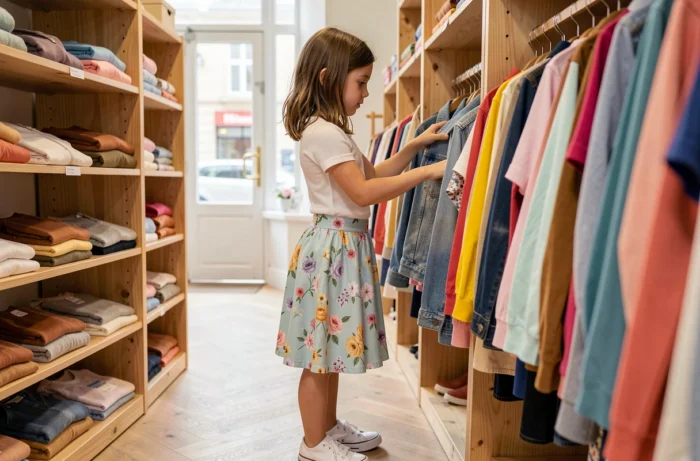
At 10 years old, a girl begins to express clear clothing preferences. She notices what her peers are wearing, rejects certain colors, and requests a specific hoodie. Choosing her clothes then becomes a matter of balancing her emerging tastes, the comfort necessary for her daily life, and the durability of the purchased items.
PFAS in children’s clothing: a criterion often overlooked
Before discussing style, we must talk about safety. French inspections reported in September 2026 detected PFAS in six out of ten waterproof children’s items tested. The affected products (coats, jackets, pants) have been withdrawn from the market.
PFAS are chemical substances used to make fabric waterproof or stain-resistant. They persist in the environment and in the human body. For a 10-year-old girl, this directly concerns rain jackets, windbreakers, and certain outdoor pants.
Have you ever checked the composition of a legging or a dress before buying? The list of materials is on the inner label, but surface chemical treatments do not always appear there. Favoring brands that clearly state the absence of fluorinated treatments remains the most reliable reflex. Oeko-Tex Standard 100 or GOTS labels cover this type of verification.
When you choose all clothing for a 10-year-old girl to build a complete wardrobe, this vigilance regarding waterproof materials complements the usual criteria of size and style.
Size and fit at 10 years old: why the label is not enough
A garment labeled “10 years” may be too short for a tall child or too loose for a slim build. Children’s sizes vary significantly from one brand to another.
Measuring the child’s actual stature changes everything. Stature (standing height, barefoot) is the most reliable reference. Most brands indicate a corresponding measurement in centimeters on their size guides: 140 cm often corresponds to the 10-year range, but this is not universal.
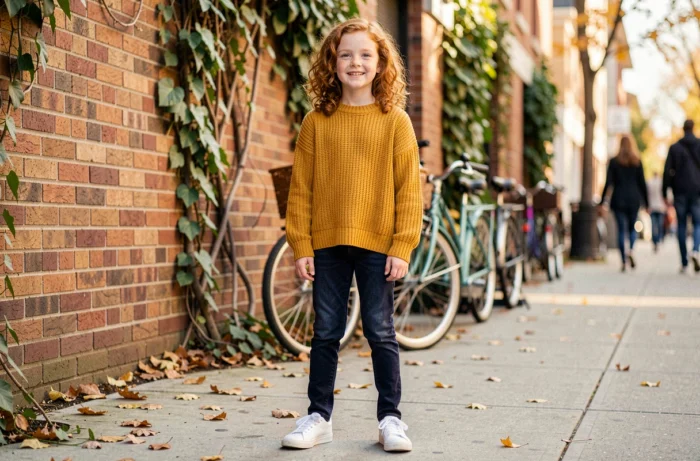
Two additional measurements help avoid mistakes:
- Waist circumference for pants and skirts. Jeans that are too tight at the waist will be abandoned at the back of the closet, even if they look good.
- Arm length for hoodies and jackets. At this age, arms grow quickly, and sleeves that are too short render a garment unusable in a few months.
- Chest circumference, useful for dresses and fitted tops. Some 10-year-old girls start to feel uncomfortable in clothes that are too close-fitting.
Taking these measurements once a season is sufficient. Investing five minutes avoids returns and frustrations.
Colors, prints, and style: supporting choices without controlling everything
Pink remains popular, but it is no longer dominant. Ten-year-old girls are eager to explore sage green, navy blue, and terracotta. Some want graphic prints, while others prefer solid colors that they mix and match themselves.
Allowing the child to compose her outfits develops her clothing autonomy. In practice, this works better when the wardrobe is based on interchangeable pieces. A pair of pants in a neutral color can be worn with several tops. A printed hoodie becomes the standout piece of a simple outfit.
The basics that transcend trends
A black or navy legging, a straight jean, two solid-colored t-shirts, and a sweatshirt form a solid foundation. These pieces absorb current desires without requiring a complete wardrobe overhaul each season.
Three well-chosen basics reduce the total number of necessary garments. The child also learns that a piece of clothing can serve in multiple contexts: school, weekends, activities.
Pieces that express personality
A patterned dress, a colorful jacket, a pair of uniquely cut pants: these elements reflect the child’s current tastes. They change more frequently, and that’s normal. The idea is to limit their number to avoid accumulation, not to eliminate them.
Penalty on ultra-fast fashion: what it changes for children’s purchases
Since September 1, 2026, new clothing sold by certain players may be subject to a penalty related to the breadth of their range and their low incentive for repair. Second-hand items are excluded from this measure. Starting January 1, 2027, advertising for these practices will also be prohibited.
In practical terms, the prices of some very cheap items could rise. For parents, this reinforces the interest in buying less but better, or turning to second-hand options.
A report published by Oxfam France in September 2026 distinguishes between emissions associated with charitable shops, commercial thrift stores, and peer-to-peer platforms. Not all second-hand circuits have the same environmental impact. The mode of delivery and the travel to pick up the item weigh as heavily as the origin of the piece.
Building a wardrobe suitable for a 10-year-old: the concrete method
Why buy in lots rather than piece by piece? Because a wardrobe designed as a whole avoids duplicates and orphaned outfits.
Here’s a simple approach:
- Sort through existing items with the child, identifying what is too small, what is no longer worn by choice, and what remains functional.
- List the gaps by category: bottoms, tops, outer layer, dressy outfit. This avoids buying four t-shirts when a pair of pants is missing.
- Set a budget by category, reserving a margin for the “favorite” piece that the child will choose alone.
- Check compositions and treatments before finalizing a purchase, especially for waterproof items.
Involving the child in the choice reduces unworn clothing. At 10 years old, she knows what physically bothers her (seams, elastics, scratchy materials) and what she socially refuses. Taking her feedback seriously also reduces waste.
A functional wardrobe for a 10-year-old girl often fits within about twenty pieces, excluding underwear. The right reflex remains to check the quality of seams, the flexibility of fabrics, and the absence of concerning substances, then let style follow the child’s desires.