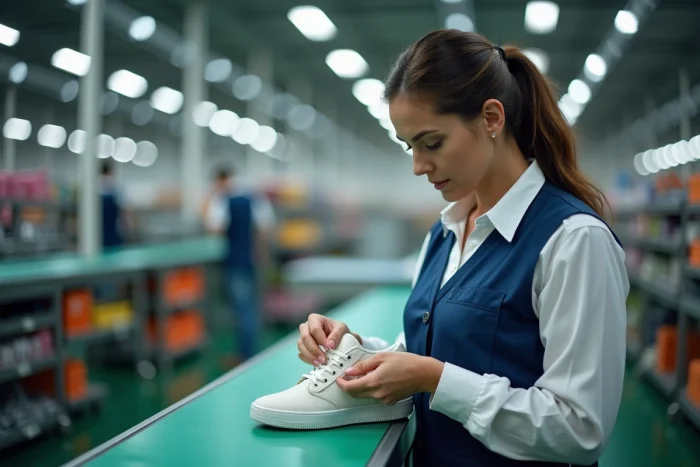
A figure dominates the debate: over 70% of Skechers sold worldwide come from Asian factories. Far from the Californian myth, the reality of the brand is first written on the other side of the globe, between giant assembly lines and remote digital control.
Understanding the origin of Skechers shoes: between globalization and know-how
The industrial history of Skechers begins in Manhattan Beach, California. From its inception, Skechers USA, Inc. established itself in the market, driven by exponential demand and an ever-growing range of models. To cope with this boom, the brand quickly bet on globalization: heading to Asia, where production reaches new heights. But while manufacturing is relocated, California remains in control. Thanks to the digital tools of Centric Software and a sophisticated PLM system, every step is managed remotely, from design to delivery.
The strength of Skechers shoes also lies in innovation. Take memory foam: this material, which has become the signature of Skechers comfort, symbolizes the brand’s technical requirements. Nothing is left to chance, from material selection to mastering the manufacturing process. This precision ensures products that are both high-performing and adapted to the fast pace of global production.
Consumers are increasingly questioning the origin of products. Where are Skechers made? A legitimate question that leads to the resource manufacturing of Skechers shoes: origin and production sites – Mademoiselle Camille. Understanding these mechanisms means grasping the ongoing balance between cost optimization, stylistic choices, and brand reputation.
From the Energy model to the latest releases, each collection illustrates Skechers’ adaptability. Here, style and comfort do not result from soulless automated production. They rely on a subtle combination of localized know-how and mass assembly lines, proving that globalization and quality demands are not incompatible.
Where are Skechers actually made? Focus on the main production sites
To understand the behind-the-scenes, one must look at where the Skechers workshops are located. Management is done from California, but the key production centers are in China and Vietnam. Two countries that today concentrate the bulk of the brand’s global manufacturing.
In China, industrial expertise and the ability to produce at scale make the difference. The flagship models are assembled there at a steady pace, with costs that allow Skechers to maintain its competitiveness. Meanwhile, Vietnam is increasingly recognized for the quality of its finishes and adherence to international standards. Vietnamese production lines specialize in models where precision and durability are at the heart of expectations.
Here are the strengths present in these two major manufacturing hubs:
- China: champion of volume, automation, and speed.
- Vietnam: a reference for finish quality and alignment with global standards.
This industrial setup combines innovation, responsiveness, and tight cost management. The advanced technologies integrated into the factories, along with continuous monitoring using tools like Centric PLM, ensure product compliance and reliability. It is this careful balance that allows Skechers to offer a solid quality-price ratio, while staying in tune with international market expectations.

Social responsibility and ethics: what concrete commitments does the brand make?
Observing Skechers’ social responsibility means measuring a global brand’s ability to combine industrial ambitions with ethical expectations. Skechers claims to closely monitor its Asian sites, particularly in China and Vietnam, where the majority of its shoes are produced.
The brand highlights the regularity of its audits conducted at its partners to verify compliance with social and environmental rights. These checks focus on working conditions, safety, and adherence to local laws. However, communication remains controlled: few detailed reports are made public, with Skechers preferring to emphasize its commitments and the robustness of its quality controls.
The principles promoted by the brand are concretely translated into:
- Respect for legal working hours and exclusion of child labor.
- Strengthening quality control at every stage of manufacturing.
- Occasional actions for the health and safety of employees.
Skechers collaborates with independent organizations to ensure compliance with these rules. Yet, the complexity of subcontracting makes it difficult to have a comprehensive view of each workshop. The question remains: can the brand reconcile social demands and market pressure in a context where the demand for fashion and excellence does not wane, particularly in France?
Ultimately, choosing a pair of Skechers also means wearing a piece of this globalized story, caught between profitability demands and collective awareness. Will tomorrow’s consumer weigh more on ethics than on style or price? The answer will likely hang in the balance, between real transparency and ever-higher expectations.