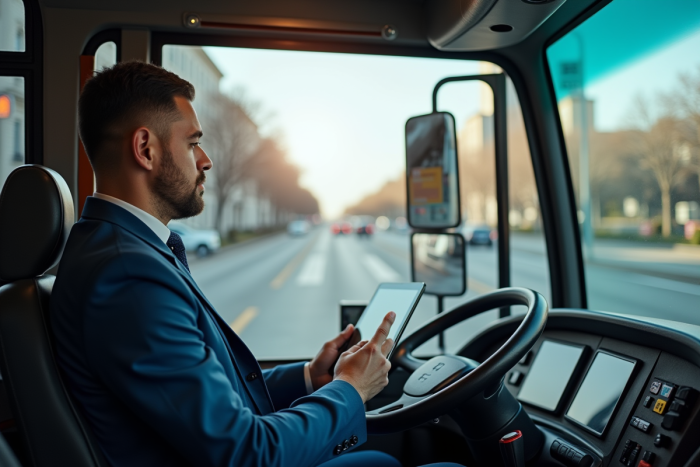
A tram that comes to a stop, rails that still vibrate, and here comes the reality hitting: taking a leave without leaving the platform, mission impossible? The smartphone lights up, but the door to HR tools often remains locked for those without direct access to the air-conditioned offices. Between the rhythm of staggered schedules and the noise of the depots, the question of access to human resources arises, urgent, concrete, sometimes frustrating.
Behind every uniform, public transport agents face the same administrative obligations as any employee. Yet, to report a sick leave or check a payslip, waiting for a break in an isolated room is still the norm. Station after station, HR management turns into a traveling puzzle, far from being just a technical detail: it’s a daily challenge, invisible but heavy.
The challenges of accessing HR tools for public transport agents
Accessing HR tools when working in public transport often resembles an obstacle course. Drivers, technicians, or reception agents all juggle with staggered schedules and constant mobility, confronted with access barriers to internal information systems. Far from administrative headquarters, every administrative step becomes complicated:
- clocking in, retrieving a payslip, submitting a document, or following a training requires a reliable connection — a luxury rarely available on the lines or in the depots.
The management of human resources in transport operates in a context where the continuity of public service imposes its rules. For companies eager for efficiency, providing accessible tools, even while on the go, becomes imperative. Added to this challenge is the issue of professional equality:
- HR practices must take into account every profile, every career path, without distinction of position or gender.
The platform Urban Group RATP is a perfect illustration. To check their rights, make a request, or communicate with HR, each agent must be able to easily access their dedicated space. But on the ground, obstacles persist:
- the multiplication of passwords, lack of equipment, labyrinthine interfaces, all barriers that hinder access and widen the gap between agents and their employer.
- Inaccessible tools as soon as the offices close
- Unreliable connection in certain vehicles or isolated sites
- Digital training too rare or unsuitable for the agents’ pace
On the ground, HR management in transport therefore requires responses that match mobility, unpredictability, and the fragmentation of daily life. The Urban Group RATP platform, often cited as an example, is the subject of recurring questions about its access methods, as highlighted in the article “UrbanGroup RATP Net: how to access it? – Mon-business-en-ligne.com.”

What concrete solutions for smooth HR management on the ground?
Modernizing HR tools in public transport means adapting technology to the ever-changing reality of the sector. Companies in the sector, faced with the frantic pace of lines and off-schedule hours, must reinvent access to HR services. The development of dedicated mobile applications paves the way: interfaces designed for mobile use, accessible from any platform, depot, or cabin. The user experience then takes on its full meaning:
- requesting leave, checking pay, consulting a training plan… everything becomes possible in just a few clicks, even between two stops.
Personalized support changes the game. Training teams on the ground, providing clear practical guides, organizing exchange times with HR referents: this is how to dispel apprehensions and promote autonomy. This human network, combined with collaborative tools, streamlines exchanges and reduces response times. Agents gain in responsiveness, HR in proximity.
- Operational mobile applications, even in total mobility
- Practical guides for every use, accessible to all
- On-the-ground support by identified HR relays
Professional equity remains the common thread of these transformations: ensuring that every employee, regardless of their mission or location, receives the same level of service. In this sector where every minute counts, the user experience becomes the best ally of modern and adapted HR management. The question remains whether tomorrow, even between two signals, the tram or bus will become the new offices for daily administrative tasks.